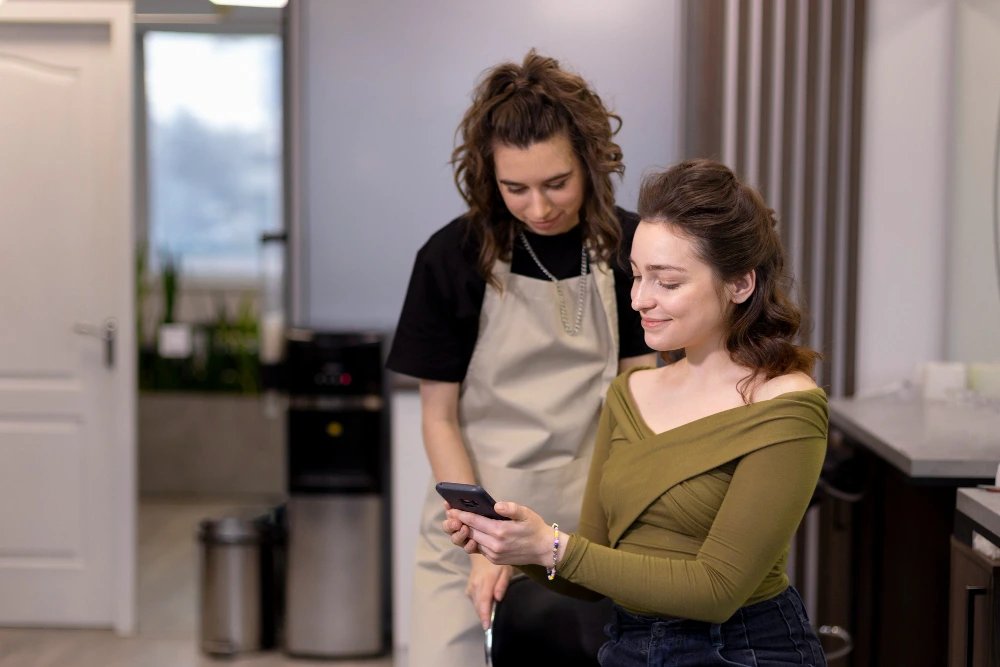
The beauty industry has moved well beyond paper appointment books and phone calls. Clients now expect to book in seconds, preview a new hair colour on their phone, and receive product suggestions that suit their skin. Salon owners want fewer no-shows, fuller schedules, and less admin work. An AI-powered salon app delivers both, and in 2026 it is one of the most practical ways for a beauty business to stand out.
This guide explains what an AI salon app is, which features matter, what it costs, and how to build one step by step.
What Is an AI Salon App?
An AI salon app is a mobile or web platform that uses artificial intelligence to personalise and automate the salon experience. A basic booking tool only records appointments. An AI-driven app goes further: it predicts demand, suggests services, answers client questions, and shows clients how a look will suit them before they commit.
The intelligence layer usually combines computer vision, machine learning, and natural language processing. Together, these power virtual try-ons, smart scheduling, personalised recommendations, and conversational assistants.
Who Uses the App?
A well-designed app serves three groups from one connected system:
- Clients who book services, try looks, and buy products
- Stylists and staff who manage schedules, client histories, and earnings
- Salon owners and admins who track revenue, inventory, and performance
Why Build an AI Salon App in 2026?
Several trends make this a good moment to invest.
Client Expectations Have Changed
People are used to personalised experiences from shopping and streaming apps. They now expect the same from beauty services, including instant booking, relevant offers, and easy rebooking.
Margins Are Tight
Empty chairs, last-minute cancellations, and manual admin eat into profit. AI reminders, waitlist automation, and demand forecasting directly reduce this waste.
Technology Is More Accessible
Pre-trained vision models, cloud AI services, and cross-platform frameworks have lowered both the cost and the skill barrier for building these features.
Differentiation Matters
In a crowded market, a branded app with try-on technology and smart rebooking gives a salon something competitors lack.
Must-Have Features of an AI Salon App
Features fall into core functions, AI-powered extras, and admin tools. Start with the core and layer the intelligence on top.
Core Features
- Smart booking and scheduling with real-time availability, service selection, stylist choice, and calendar sync
- User profiles with saved preferences, past services, allergies, and favourite stylists
- Secure payments through cards, wallets, UPI, tips, deposits, and refunds
- Push notifications for reminders, offers, and rebooking prompts
- Staff management covering shifts, commissions, leave, and performance
- Reviews and ratings that build trust
If you want to launch quickly and test the market, a focused salon booking app development approach covers these essentials without overbuilding.
AI-Powered Features
Virtual try-on is the most eye-catching feature. Using the phone camera, the app overlays hairstyles, colours, makeup, or nail designs on the client’s live image. It is typically built as an AR virtual try-on app, combining face tracking with real-time rendering. It removes the “will I like it?” doubt that causes hesitation and post-service disappointment.
Personalised recommendations come next. Machine learning analyses booking history, face shape, skin tone, and trends to suggest services and products that fit each client.
An AI chatbot answers pricing questions, books slots, and handles rescheduling at any hour. Many salons build this through AI chatbot development so the assistant speaks in the brand’s own voice.
Other useful AI capabilities include:
- Demand forecasting that identifies peak and slow periods, so owners can adjust staffing and run targeted promotions
- No-show prediction that flags risky bookings and triggers reminders, deposits, or waitlist offers
- Skin and hair analysis that assesses condition from an image and recommends treatments or retail products
- Smart inventory management that tracks product usage and predicts when to reorder
Admin and Analytics Features
Owners need a dashboard showing revenue trends, client retention, top-performing stylists, and service popularity. AI-generated insights, such as “Tuesday afternoon slots are underused; consider a discount,” turn raw data into decisions.
Recommended Tech Stack
The right stack depends on budget and scale, but a common 2026 setup looks like this:
- Front end: Flutter or React Native for iOS and Android from one codebase
- Back end: Node.js, Python (Django or FastAPI), or Laravel
- Database: PostgreSQL or MongoDB
- AI and ML: TensorFlow, PyTorch, large language model APIs, MediaPipe, or ARKit and ARCore for try-on
- Cloud: AWS, Google Cloud, or Azure
- Payments: Stripe, Razorpay, or PayPal
- Notifications: Firebase Cloud Messaging and Twilio
Cross-platform development keeps costs down, while native builds suit apps that depend heavily on advanced AR performance.
How to Build an AI Salon App: Step by Step
Step 1: Research and Define the Idea
Study competitors, interview salon owners and clients, and decide who the app is for: a single salon, a multi-branch chain, or a marketplace connecting many salons and freelancers. A clear scope prevents expensive changes later.
Step 2: Plan Features and Create a Roadmap
List features by priority. Separate what is needed at launch from what can wait for later versions.
Step 3: Design the Experience
Beauty is visual, so design carries real weight. Strong UI/UX design services produce clean flows, appealing visuals, and a booking journey that takes under a minute. Test wireframes with real users before development begins.
Step 4: Build an MVP
Rather than building everything at once, launch a minimum viable product with booking, payments, and one or two AI features such as recommendations or a chatbot. MVP development services let you validate demand, gather feedback, and refine before spending the full budget.
Step 5: Develop and Integrate AI
Developers build the back end, APIs, and apps, then integrate the AI models. Training data quality matters here. Virtual try-on needs diverse images covering different skin tones, hair types, and lighting conditions so results work for everyone.
Step 6: Test Thoroughly
Test functionality, performance, security, and device compatibility. For AI features, check accuracy and bias, and run real-world trials in actual salons.
Step 7: Launch, Monitor, and Improve
Release on the App Store and Google Play, track usage and retention, and update regularly. AI models improve as they gather more data, so post-launch iteration is where much of the value appears.
AI Salon App Development Cost in 2026
Cost varies with features, platform, design complexity, and the team you hire. The ranges below are typical estimates, and actual quotes will differ.
|
App Type |
Estimated Cost (USD) |
Typical Timeline |
|
Basic booking MVP |
$15,000 – $30,000 |
2–3 months |
|
Mid-level app with AI recommendations and chatbot |
$35,000 – $70,000 |
4–6 months |
|
Advanced app with AR try-on, analytics, and multi-branch support |
$75,000 – $150,000+ |
6–10 months |
What Affects the Cost?
- Feature complexity: AR try-on and skin analysis cost far more than standard booking
- Platform choice: one cross-platform app is cheaper than two native apps
- Design quality: custom animations and branded interfaces add effort
- Team location and model: rates vary by region and by whether you hire freelancers, an agency, or an in-house team
- Third-party integrations: payment gateways, CRMs, and calendar tools add time
- Maintenance: budget roughly 15–20% of the build cost each year for updates, fixes, and servers
For a deeper breakdown of budgeting, this overview of mobile app development cost is a useful starting point. If your needs go beyond a standard template, custom software development gives you full control over features, data, and branding.
Common Challenges and How to Avoid Them
Data Privacy
Face images and health-related details are sensitive. Comply with GDPR, CCPA, and local laws, encrypt data, and ask for clear consent.
AI Accuracy
Poor try-on results frustrate users. Invest in diverse training data and keep testing.
Low Staff Adoption
If stylists find the app confusing, they will avoid it. Involve them early and keep their interface simple.
Overbuilding
Launching too many features at once raises cost and delays feedback. Start lean.
Choosing an experienced AI app development company reduces these risks, since a good partner has already solved many of these problems on earlier projects.
Conclusion
An AI salon app helps beauty businesses book more clients, cut no-shows, personalise service, and run more efficiently. The winning approach is to start with a focused MVP, add AI features that solve real problems, and keep improving with user data. With the right plan, design, and development partner, 2026 is an ideal year to launch.
Frequently Asked Questions
1. How much does it cost to develop an AI salon app?
Most projects cost between $15,000 and $150,000 or more. A simple booking MVP sits at the low end, while apps with AR try-on, analytics, and multi-branch support sit at the high end. Features, platform, and team location are the biggest factors.
2. How long does it take to build an AI salon app?
A basic MVP takes about 2 to 3 months. A mid-level app with AI recommendations and a chatbot usually needs 4 to 6 months, and an advanced platform can take 6 to 10 months.
3. What are the most important features of an AI salon app?
The essentials are online booking, secure payments, client profiles, notifications, and staff management. The most valuable AI additions are virtual try-on, personalised recommendations, a chatbot, no-show prediction, and demand forecasting.
4. Can small salons afford an AI app?
Yes. Small salons can start with a lean MVP covering booking and one AI feature, then expand as revenue grows. Cross-platform development also keeps early costs manageable.
5. Is client data safe in an AI salon app?
It can be, if the app is built correctly. Use encryption, secure servers, limited data collection, and explicit user consent, and comply with privacy laws such as GDPR and CCPA. Face and health-related data need extra care.
6. How does an AI salon app make money?
Common models include booking commissions, salon subscriptions, client memberships, in-app product sales, featured listings, and paid premium features. Most apps combine several of these.